
The Factions of the Seven Seas
Pirates, Navy and Merchants: three ways of living at sea, held together by a balance of hunting, law and trade.
You begin under no flag. On reaching level 30 the choice window opens: you raise one of the three flags, and from then on your faction decides who you may trade with, who you may attack, which buildings and research open up, and which exclusive ship your shipyard may launch.
The first choice is free, and it is not for ever: changing flag later costs 50 doubloons and 1 days must pass between two changes (see the bottom: a turncoat's act leaves a mark).
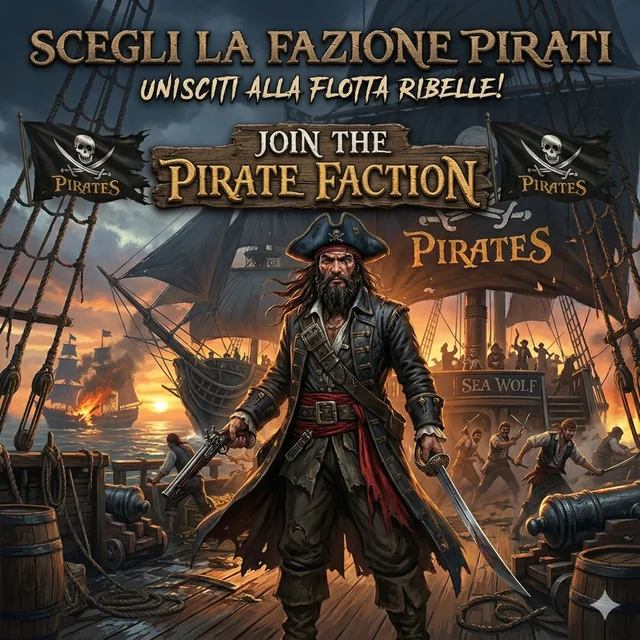
Pirates
They live by boarding and plunder, and band together in Brotherhoods to share the spoils. Every successful raid raises the bounty on their heads.
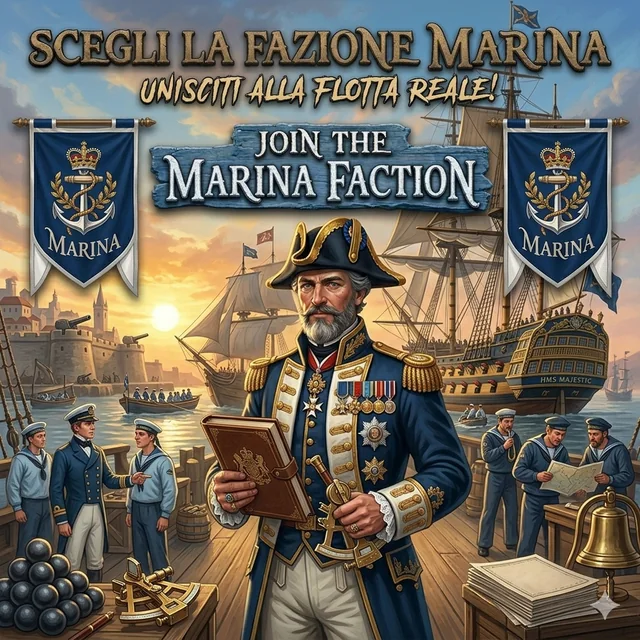
Navy
The Crown's law: it hunts wanted pirates to collect their bounty, inspects the ports and takes a share of the dues. The open sea is its hunting ground.
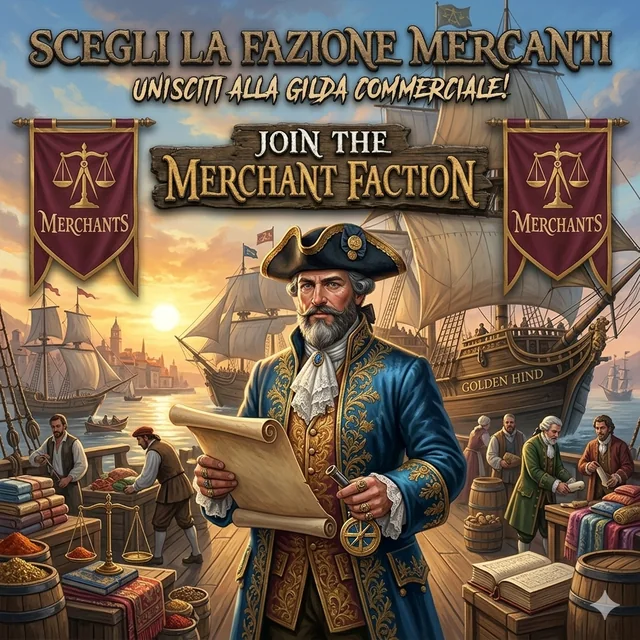
Merchants
Masters of the trade routes: they carry other captains' goods, open stalls in ports and on other islands and, when it pays, turn a blind eye to the cargo.
🏴️ Pirates — the taking
- Boarding: they alone can board a battered ship with the grapnel and carry off its hold.
- Brotherhood: found one or join one, and your companions open their islands to you (see below).
- Armoury: special shot and the boarding grapnel, which no other flag forges.
- Exclusive ship: Goletta (Shipyard lv. 6).
- The price: plunder and sinkings raise your bounty, and with a bounty on your head the Navy hunts you on the open sea. Merchant and Navy islands stay hostile to you.
⚖️ The Navy — the law of the seas
- Capture: by sinking a pirate with a bounty on the open sea you collect the whole reward from the royal treasury, and wipe theirs out.
- Inspection and shadowing: moored at a non-pirate island you can inspect the ships at anchor beside yours and quietly mark a wanted pirate (it costs 200 doubloons from the island's coffers). For the next 24 hours you are told every time that pirate sets sail: the marked one never knows.
- Collector of dues: 5% of the dues paid at the ports and 10% of the fee Merchants earn on delivery flow into the Navy treasury. Every 24 hours the treasury is split in equal shares among the active sailors (seen in the last 7 days and not on vacation): if nobody qualifies, it is held over.
- Armoury: special shot of every calibre.
- Exclusive ship: Fregata (Shipyard lv. 6).
- The price: pirate islands stay closed to you — no mooring and no trading there, not even where the bazaar is open to all.
💰 Merchants — free trade
- Courier: take on other captains' transport orders and collect the fee on delivery (less the Navy's tax).
- Stalls: open a stall on other players' islands and buy selling space in the ports' bazaars — a stall sells only while your ship is moored there.
- Armed escort: you can hire an NPC guard ship that sails with you.
- Smuggling: selling to Pirates pays better, and the Navy cannot prove it until they stop you at sea (below).
- Exclusive ship: Nave Mercantile (Shipyard lv. 8).
- The real advantage: you are neutral. The Navy does not attack you on sight — that neutrality breaks only if you are caught smuggling.
☠️ The Bounty
The bounty is the "price on the head" of a Pirate, the measure of how dangerous they are:
- It rises when they plunder ships, besiege islands or sink other players (sinking counts for more).
- It falls only while the pirate stays holed up in port and idle: as soon as they sail out to raid, it starts climbing again.
- It is wiped out when the Navy sinks them on the open sea and collects the reward.
For a Pirate it cuts both ways: a high bounty is prestige and terror, but also a target painted on your back.
📦 Smuggling — Merchants against the Navy
Smuggling means trading with Pirates. The goods do not matter: the buyer does. Every sale to a Pirate made with your own ship on the spot makes you a suspect — taking on one of their transport orders, filling a "Wanted" request at their island, a purchase at your stall on someone else's island. What falls outside is a Pirate buying at the bazaar of your island: that cargo leaves on their ship, and there is nothing aboard yours to inspect.
- Heat: every sale lights (or renews) 30 minutes of suspicion and adds up the value of what you sold. While the heat is on you can be inspected, even after you have delivered. If it runs out without your being stopped, you got away with it.
- While you sell you are moored, and a moored ship cannot be inspected: the Navy stops you when you leave.
- No signal: there is no marker flagging the guilty. The Navy inspects on a hunch, from routes and context.
The inspection
The Navy pulls alongside a merchant ship under way (within 300 units, on the open sea too) and demands to see the cargo. The Merchant gets a window with 30 seconds to decide, and meanwhile both ships lie still:
- Refuse → that is a confession: you become attackable for 20 minutes without their having to find anything.
- Accept (or let the time run out: silence counts as a yes) → the dice are rolled. If they find the contraband you are attackable; if they find nothing you sail on free.
- An empty inspection costs the Navy a fine of 50 doubloons, which vanish (they do not go to the Merchant), and the same ship cannot be stopped again for 10 minutes. To begin an inspection the Navy must have at least the amount of the fine aboard.
Discovery, skill and seizure
- Odds: a novice is caught 70% of the time; as inspections pile up the Smuggling skill brings the risk down to a floor of 45%. However good they get, a smuggler is still caught about one time in two.
- The skill grows only with contraband truly aboard — more when you get away with it, a little even when you are caught (you learn from mistakes), and no more than 20 points a day: it cannot be maxed out in an afternoon.
- Seizure: once the Merchant is exposed, the Navy has the licence to fire, not the loot. If it sinks them, the contraband is seized (the Navy takes no goods: it earns points worth 25% of the value seized) and the rest of the hold goes down as always. If the Merchant runs and delivers, they have won.
- The Pirate who placed a sunk order loses the goods but not the gold: what was held is refunded, with a notice.
- Why risk it: orders placed by a Pirate carry a fee raised by 20%.
While you are exposed your band does not protect you: the Navy may fire on you whatever your level (see Player protection).
The outcome reaches both sides, each from its own point of view: on screen while sailing, in the bell and — for the exposed Merchant alone, who must act at once — by push notification and Telegram as well.
⚓ Customs for a fee
To moor at another player's island you need a Customs permit. The owner may grant it free or put it up for sale at a price (a toll): whoever pays gets a temporary permit. Manage the toll and your purchases from the Customs window on your island (you must have the Customs House built).
⚔ Pirate Brotherhoods
Pirates can found or join a Brotherhood: a blood pact between captains. Members of the same Brotherhood get automatic mooring permits at their allies' islands and are told at once when a companion's island is besieged.
Every faction can look up the active Brotherhoods and their members on the Brotherhoods page, where each flag has its own ordering: Pirates by Brotherhood, the Navy by nation, Merchants and Stateless in a single list.
🏳️ Staying under no flag
Nobody forces you to choose: you can keep sailing as Stateless. It is not a fourth faction with advantages of its own, it is the absence of a flag — no exclusive ship, no faction buildings or research, no Flagship (a flag is needed to lay its keel) and, in a colony, only the common buildings. In exchange you have no enemies by default: nobody hunts you for wearing the wrong colours.
Sieges: captains belonging to Navy, Merchants do not besiege other captains' islands. Every other flag can.
🔄 Changing faction
Changed your mind? From Character → Change Faction you move to another flag by paying 50 doubloons, and 1 days must pass between two changes. It is a turncoat's act, and it has consequences depending on which faction you leave:
- If you were a Pirate, you lose your bounty.
- If you were a Merchant, you lose your trade points.
- Either way, any non-basic clothing is taken off your avatar (it stays in the warehouse and you can put it back on).